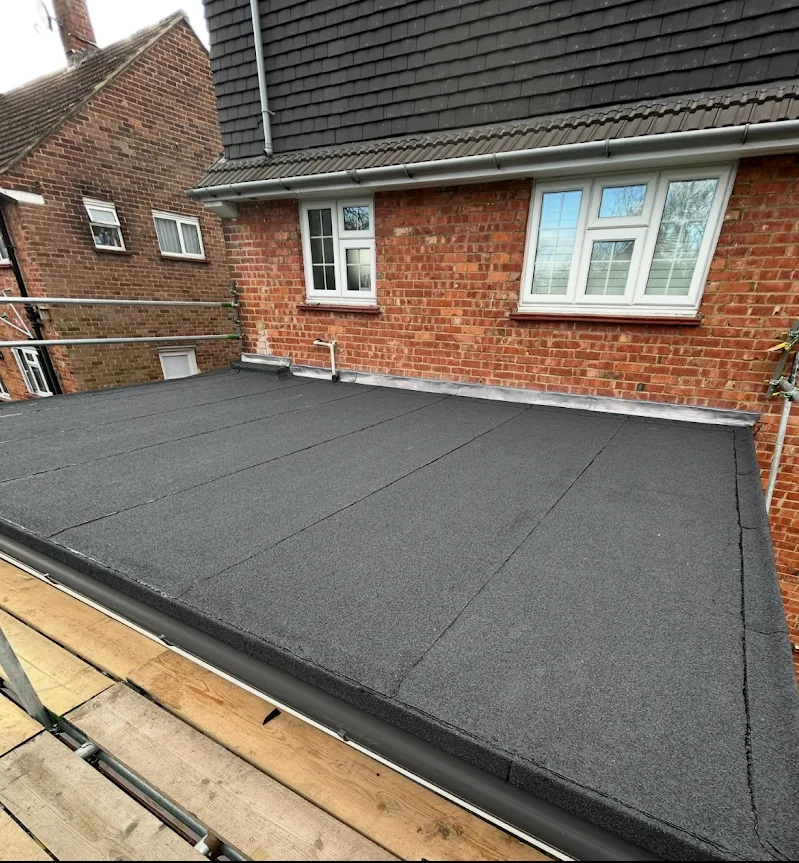
GRP vs felt vs liquid roofing is the choice most homeowners face when a flat roof needs replacing. The short answer: there is no single best flat roof. GRP fibreglass suits roofs that get walked on and small roofs with lots of detail. Modern multi-layer felt suits most extensions and commercial roofs and comes with strong manufacturer guarantees. Liquid roofing is ideal for awkward shapes, balconies and refurbishing a sound existing roof. What matters just as much is how the roof underneath is built and who installs it.
We are a Bauder Approved Contractor, and we install all three systems on extensions, garages, dormers, balconies and commercial buildings across Croydon, Surrey and Bromley. Here is how they compare.
GRP, felt and liquid roofing at a glance
| GRP fibreglass | Modern felt (reinforced bitumen) | Liquid roofing | |
|---|---|---|---|
| Finish | Hard, seamless, can be coloured | Mineral or smooth finish, laid in overlapping layers | Seamless coating, reinforced with a fleece |
| Joints | None, laid wet as one piece | Overlapping, heat or self-adhesive sealed | None, painted on in layers |
| Foot traffic | Good, suits balconies and walkways | Good with the right top sheet | Good, suits balconies and walkways |
| Complex details | Very good, forms around shapes | Good | Excellent, goes around almost anything |
| Over an existing roof | No, needs a new timber deck | Usually stripped back first | Often yes, if the existing roof is sound |
| Best for | Balconies, dormers, small extensions | Extensions, garages, commercial roofs | Balconies, awkward details, refurbishment |
GRP fibreglass
GRP stands for glass reinforced plastic. A resin is laid over a glass fibre mat on a timber deck and cures into a hard, seamless sheet with a coloured topcoat. Because there are no joints, there are fewer places for water to get in.
Pros
- Seamless finish with no joints
- Hard wearing and can be walked on, so it is good for balconies and roof terraces
- Forms neatly around roof lights, upstands and awkward shapes
- Clean, tidy look that suits modern extensions
Cons
- Needs dry weather to install, as the resin can't be laid in rain or very low temperatures
- The quality depends heavily on the installer, as mixing and laying the resin is a skilled job
- Can crack if the deck underneath moves, which is why the deck must be solid and properly fixed
We offer a 20-year guarantee on GRP flat roofs we install.
Modern felt: not the shed felt you remember
When people hear "felt roof" they picture thin shed felt that splits after a few summers. Modern felt roofing is a different product. Today's systems use reinforced bitumen membranes, laid in two or three layers and bonded together with heat or self-adhesive. Each layer backs up the one above.
As a Bauder Approved Contractor, we install Bauder's bituminous systems. Being approved means Bauder has checked our installation standards, which lets us offer a manufacturer's product warranty on Bauder systems, on top of our own workmanship guarantee.
Pros
- Multiple layers give built-in redundancy
- Strong manufacturer-backed guarantees when fitted by an approved installer
- Handles building movement well
- A proven choice for commercial and larger domestic roofs
Cons
- Traditional torch-on systems use a flame, so installers must be trained and follow fire safety procedures (self-adhesive options exist for sensitive jobs)
- The finish looks more traditional than GRP
Liquid roofing
Liquid roofing systems, such as liquid plastic and Sealoflex, are applied as a liquid in layers with a reinforcing fleece bedded in. They cure into a seamless, flexible waterproof coating that follows the shape of whatever is underneath.
Pros
- Seamless, with no joints or laps
- Goes around pipes, roof lights, upstands and awkward corners with ease
- Can often be applied over an existing roof that is sound, which avoids a full strip-off
- Cold applied, so there is no naked flame on site
- Walkable, so it suits balconies and terraces
Cons
- The existing surface must be sound, clean and dry, so it won't fix a rotten deck
- Needs suitable weather to apply and cure
- Coating thickness matters, so it must be applied carefully by a trained installer
We also use liquid systems alongside GRP and felt to seal tricky junctions, such as where a flat roof meets a wall or a roof light.
The part nobody sees: warm roof construction
The top layer is only part of the story. Many older flat roofs are built as "cold roofs", with insulation between the joists below the deck. These are prone to condensation, which rots the deck from underneath and can look like a leak.
A warm roof puts the insulation on top of the deck, under the waterproof layer. This keeps the deck warm, avoids condensation, and is the usual way to meet current building regulations when a flat roof is replaced. Whichever top layer you choose, ask your roofer how the whole roof will be built, not just what goes on top.
GRP vs felt vs liquid roofing: which should you choose?
- Balcony or roof terrace: GRP or a liquid system, for a hard surface that can be walked on.
- Dormer or small extension with roof lights: GRP forms neatly around the details.
- Rear extension or garage: GRP or a Bauder felt system both work very well. The choice often comes down to looks and guarantee.
- Sound roof that needs refurbishing, or lots of awkward details: a liquid system.
- Commercial or industrial building: a Bauder single-ply or multi-layer bituminous system with a manufacturer-backed guarantee.
The right answer for your roof depends on its size, how it will be used, what is around it, and the condition of the deck underneath. We'll recommend a system at your free survey and explain why. See our flat roof installation service or, for businesses, our commercial flat roofing.
Frequently asked questions
Which flat roof lasts the longest?
All three systems can last for decades when they are installed properly on a sound, well-built deck. Installation quality and the build-up underneath make a bigger difference than the choice of top layer. Always check the length of the written guarantee and who backs it.
Can a new flat roof go over my old felt roof?
With a liquid system, sometimes, if the existing roof is sound and dry underneath. For GRP and felt we usually strip back to the deck, check it, and replace any damaged boards first, because overlaying can hide a rotten deck or trapped moisture. If your roof only has a localised problem, a flat roof repair may be all you need.
Do I need building regulations approval for a new flat roof?
Replacing more than a quarter of a roof's covering is usually treated as renovation under building regulations, which normally means upgrading the insulation. A warm roof build-up is the usual way to do this. Read our guide to planning permission and building regulations for a new roof for more detail.