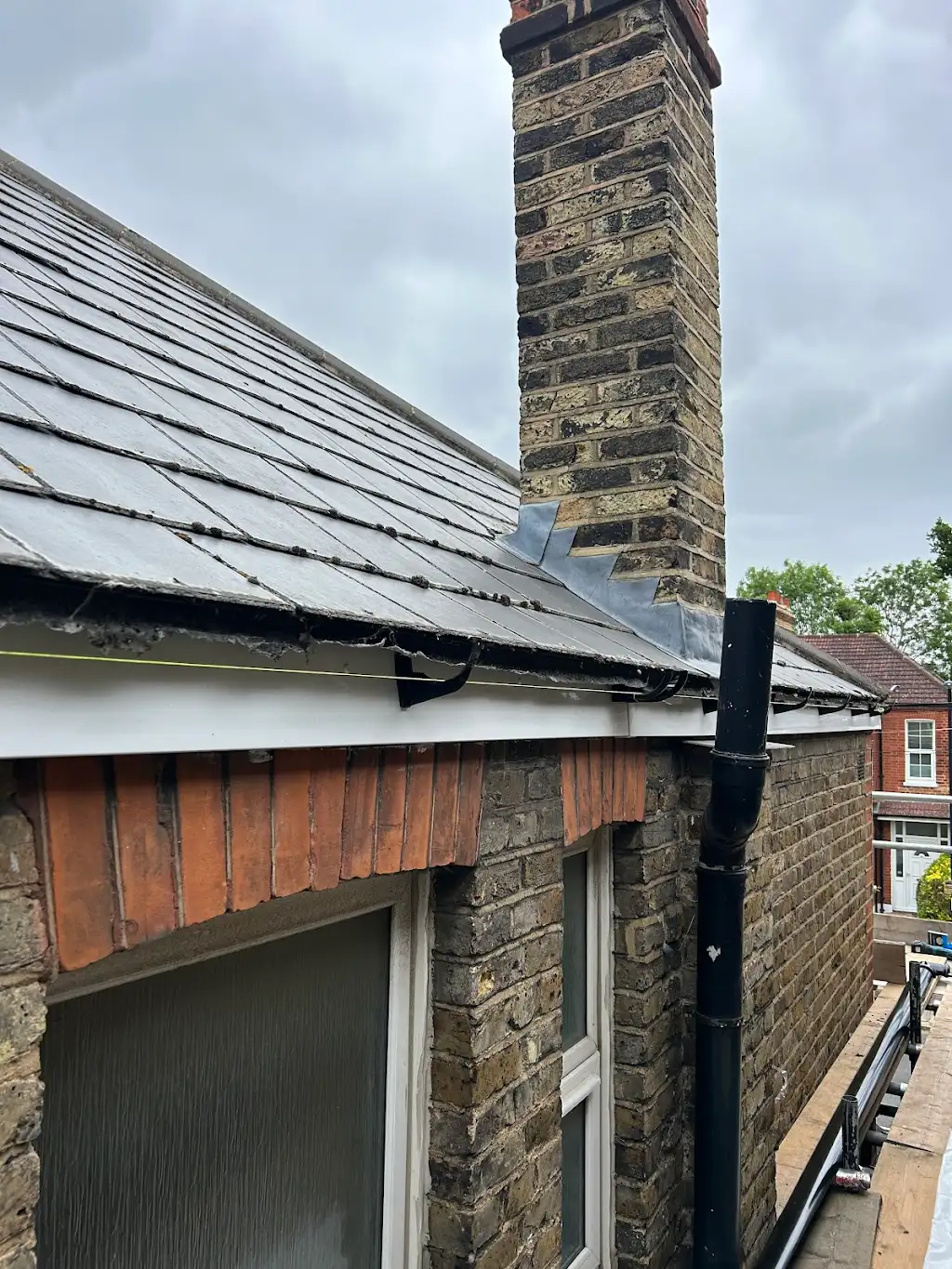
Working through an autumn roof checklist now is the cheapest way to avoid a leak in January. The storm season in the UK usually runs from October to March, leaves fill gutters in October and November, and roofers' diaries fill up quickly once the first big storm hits. A small problem you spot today is a quick repair. The same problem found during a storm is often an emergency call-out and a stained ceiling.
This checklist is written for homeowners in Croydon, Bromley and Surrey, where most roofs sit on Victorian and Edwardian terraces, 1930s semis and 1960s or 70s houses with flat-roofed extensions. Every check below can be done from the ground, from a window or from inside the loft.
Before you start: stay off the roof
Please don't climb onto your roof. Tiles and slates are slippery in autumn, older slates crack underfoot, and falls from height are one of the most common causes of serious injury at home. You can see almost everything you need with:
- a pair of binoculars, or the zoom on your phone camera
- a torch for the loft
- a window that overlooks a flat roof or the back of the house
If something needs a closer look, that is a job for a roofer with the right access equipment.
The 10-point autumn roof checklist
1. Clear the gutters and downpipes
Blocked gutters are the most common autumn problem we see. When gutters fill with leaves and moss, rainwater spills over the edge and runs down the wall, soaking brickwork and rotting fascia boards. Look for plants growing out of the gutter, sagging sections, water marks on the wall below, and downpipes that gurgle or overflow in heavy rain.
If your gutters are at ground-floor height and you are comfortable on a stepladder, you can clear them yourself. Anything at first-floor height or above is safer left to a professional. Our gutter clearance and repair service covers this.
2. Look for slipped, cracked or missing tiles and slates
Scan each slope of the roof with binoculars. You are looking for gaps in the pattern, tiles sitting lower than their neighbours, and bits of broken tile or slate in the gutter or on the ground. A slate only needs to slip a short way to break the overlap that keeps water out.
3. Check the ridge tiles
The ridge tiles run along the top of the roof. On older roofs they are bedded in mortar, which cracks and falls out over time. Look for gaps under the ridge tiles, loose or rocking tiles, and lumps of mortar on the roof or in the gutter. Modern dry ridge systems use mechanical fixings instead of mortar, which is why we fit them on most new roofs.
4. Check the chimney stack and flashing
Chimneys are one of the most common sources of leaks on period properties. From the ground, look at:
- the brickwork, for crumbling mortar joints
- the lead flashing where the stack meets the roof, for lifting or gaps
- the flaunching (the mortar on top of the stack), for cracks
- the pots, to check they are upright and secure
A leaning pot or loose brickwork before a storm is worth getting looked at quickly. See our chimney repairs service for what we do.
5. Look at the valleys
A valley is where two roof slopes meet in a channel. Many Victorian terraces in South London have a central valley gutter hidden behind the front parapet, and these collect leaves and silt. If you can see into a valley from a window, check it is clear and that the lead lining isn't split. Blocked valleys can send water straight into the house during heavy rain.
6. Check flat roofs for ponding, blisters and splits
If you have a flat-roofed extension, dormer or garage, look at it from an upstairs window after rain. Water should drain away within a day or two. Standing water (ponding), bubbles in the surface, cracks, and loose edges are all signs the membrane is struggling.
7. Check the fascias, soffits and bargeboards
These are the boards along the edge of the roof. Peeling paint, soft or rotten timber, and dark staining often point to a gutter or roof edge problem that is letting water in.
8. Look for moss build-up
A light coating of moss is common and not a problem on its own. Heavy moss holds water against the roof, can lift tiles, and gets washed into the gutters where it causes blockages. If moss is thick enough to see from the street, it is worth having it removed carefully. Pressure washing can damage tiles, so it's best avoided.
9. Check the loft from the inside
On a bright day, go into the loft with a torch and turn the light off for a moment. Look for:
- daylight coming through the roof
- damp or dark patches on the timbers or underlay
- stained or wet insulation
- mould or heavy condensation on the underside of the roof
Condensation and leaks can look similar. If you see damp in the loft but nothing wrong outside, ventilation may be the issue rather than the roof covering.
10. Check ceilings and walls for new stains
Walk around the top floor of the house and look at the ceilings, especially in corners and around chimney breasts. A new brown stain, bubbling paint or a musty smell are early signs of a leak. Take a photo so you can tell whether it grows after the next spell of rain.
Flat roof extensions need extra attention
Flat roofs on 1960s and 70s extensions are a common source of winter leaks in Croydon and Bromley. Many are covered with older single-layer felt that is now well past its best. Pay close attention to where the flat roof meets the house wall, as this joint (the upstand and flashing) is where most flat roof leaks start.
If your flat roof is showing its age, autumn is a good time to decide between a repair and a replacement, before the weather makes the work harder. Our guide to GRP, felt and liquid flat roofs explains the options.
When to call a roofer
Call a roofer before winter if you notice any of the following:
- missing or slipped tiles or slates
- loose ridge tiles or mortar on the ground
- a leaning chimney pot or crumbling chimney brickwork
- lifted or split lead flashing
- standing water or splits on a flat roof
- daylight or damp in the loft
- a new stain on a ceiling
Hills Roofing Ltd covers Croydon, Surrey and Bromley. If a problem can't wait, our 24-hour emergency roofing service can make your roof safe and watertight. For anything else, a free survey gives you a clear picture of what needs doing now and what can wait. If you already have a leak, read why roofs leak for the most likely causes.
Frequently asked questions
When is the best time to check my roof?
Early autumn, before the leaves have fully dropped and before the first big storms. A second quick check in spring picks up any damage the winter caused.
Can I clean my gutters myself?
Ground-floor gutters, yes, if you use a stable stepladder and have someone holding it. For first-floor gutters and above, or anything that means leaning over a roof, use a professional with proper access equipment.
How often should a roof be inspected by a professional?
Once every year or two is sensible for most homes, and after any severe storm. Older roofs and flat roofs benefit from more regular checks.