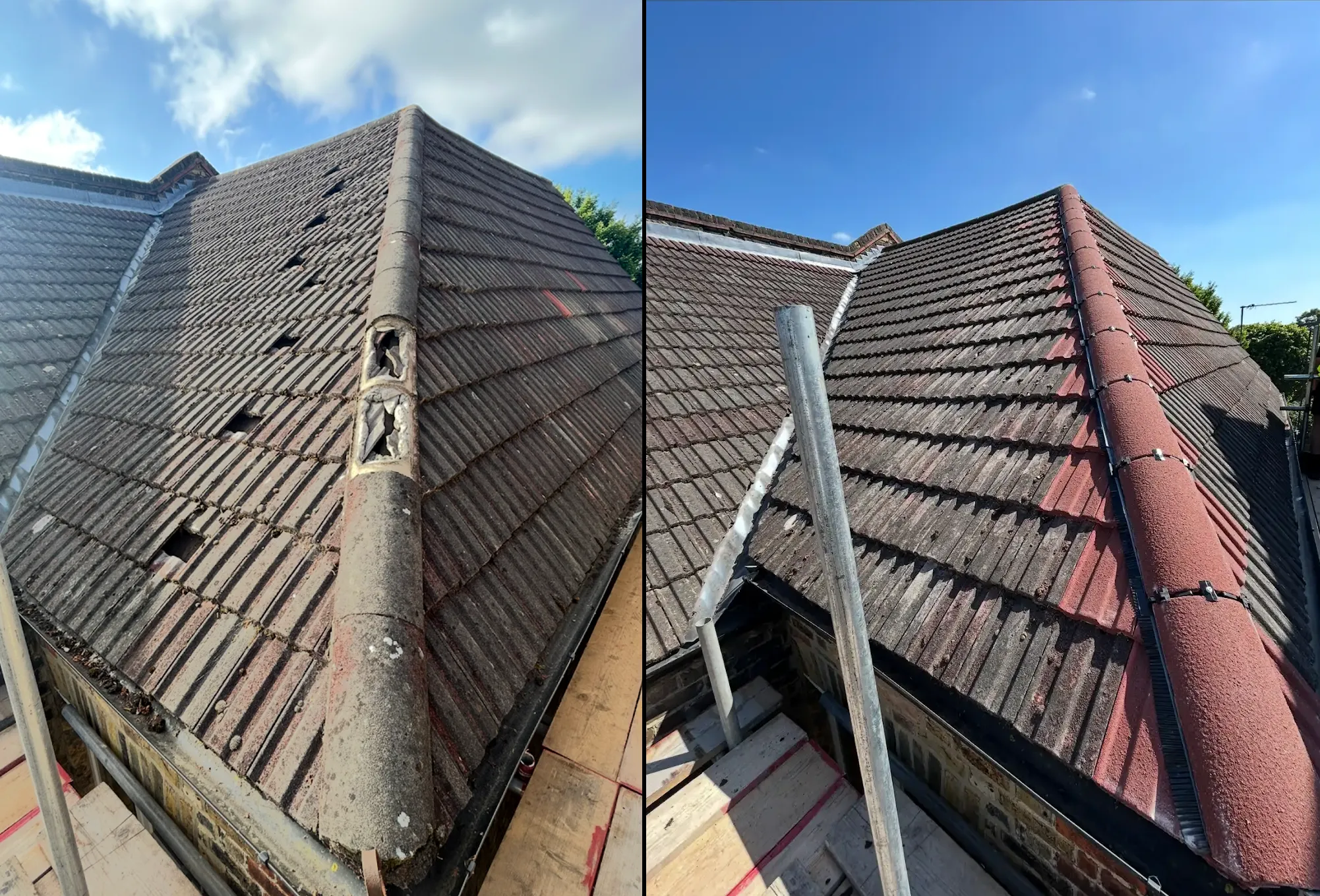
If you are asking "why is my roof leaking?", the answer is usually one of a small number of causes. The tricky part is that the damp patch on your ceiling is rarely directly below the fault. Water gets in higher up, runs along a rafter or the underlay, and drips down somewhere else entirely. That is why a proper repair starts with finding the source, not patching the stain.
This guide covers what to do right now, the eight causes we find most often on homes across Croydon, Surrey and Bromley, and how to tell a real leak from condensation.
What to do right now
- Contain the water. Put a bucket or bowl under the drip and move furniture, rugs and electronics out of the way.
- Stay safe around electrics. If water is near a light fitting or socket, switch off that circuit at the consumer unit and don't touch wet fittings.
- Relieve a bulging ceiling. If the ceiling is bulging with water, it can collapse. Put a bucket underneath and make a small hole in the centre of the bulge with a screwdriver so it drains in a controlled way.
- Check the loft. If you can get into the loft safely, put a container under the drip and look for where the water is coming from.
- Take photos. Photograph the damage inside and any visible damage outside. You will want these for your insurer.
- Stay off the roof. Wet roofs are dangerous. Leave access to a roofer.
- Call a roofer. For an active leak, our 24-hour emergency roof repair service can make the roof watertight while a permanent repair is planned.
The 8 most common causes of a roof leak
1. Slipped, cracked or missing tiles and slates
This is the most common cause of a leaking roof. Tiles and slates overlap to shed water, and one only has to move slightly for rain to get behind it. Old nails rust through (known as nail fatigue), storms lift tiles, and frost cracks older clay and slate. On many Victorian terraces in Croydon, the original slates are held by nails that are now well over a hundred years old.
2. Failed lead flashing
Flashing is the lead that seals the joints where the roof meets a wall, chimney, dormer or roof light. Lead lasts a long time, but it can crack, lift in the wind, or come away from the mortar joint it is tucked into. Flashing faults usually cause damp near chimney breasts, party walls or dormer cheeks.
3. Chimney problems
Chimneys cause a large share of the leaks we see on period homes. Water gets in through crumbling mortar joints, cracked flaunching on top of the stack, missing pots or caps, or failed flashing at the base. Water can also soak down through porous brickwork and show up as a damp patch on a chimney breast. Our chimney repairs service covers repointing, flashing and rebuilds.
4. Blocked or broken valleys
A valley is the channel where two roof slopes meet. Valleys carry a lot of water, so any blockage or split in the lead lining quickly causes a leak. Hidden valley gutters behind the front parapet of Victorian terraces are a classic source of problems, because leaves and silt collect where no one can see them.
5. Cracked ridge or verge mortar
The ridge tiles along the top of the roof and the verge along the gable edge are traditionally bedded in mortar. Over the years the mortar cracks and washes out, the tiles loosen, and wind-driven rain gets in. Dry ridge and dry verge systems replace the mortar with mechanical fixings and are far less prone to this.
6. Blocked gutters and downpipes
When gutters overflow, water can run back under the bottom row of tiles, soak the fascia, and track into the wall or eaves. This often looks like damp high up on an outside wall or at the edge of a bedroom ceiling. Clear gutters are one of the simplest ways to prevent a leak. See our guttering service.
7. Failed flat roof membrane
Flat roofs on extensions, garages and dormers are a frequent source of leaks. Older felt splits and blisters, joints open up, and water ponds in dips. The weakest point is usually where the flat roof meets the house wall. If your flat roof leaks repeatedly, it may be time to compare repair and replacement. Our guide to GRP, felt and liquid roofing covers the main options.
8. Worn out underlay
Underneath the tiles or slates sits a layer of underlay, often called roofing felt. It is the roof's second line of defence. On older roofs the underlay can become brittle, tear, or be missing altogether. A roof with failed underlay may be fine in normal rain but leak in wind-driven rain, when water gets past the tiles.
Is it a leak or condensation?
Not every wet patch is a roof leak. Condensation forms when warm, moist air from the house meets the cold underside of the roof. It is common in lofts with poor ventilation and on flat roofs built without enough insulation.
Signs it is probably condensation rather than a leak:
- the damp appears in cold weather whether or not it has rained
- the underside of the roof is wet all over, rather than in one spot
- there is mould on the timbers or droplets on the underlay
- the problem is worst in the morning
Signs it is probably a leak:
- the damp appears or grows after rain, especially wind-driven rain
- it is in one spot, often near a chimney, wall, valley or roof light
- you can see a drip line or a trail on a rafter
Condensation is solved by ventilation and insulation, not by replacing tiles. A good roofer will tell you which problem you have before quoting.
Where the stain is, and what it usually means
| Where you see the damp | Most likely causes |
|---|---|
| Around a chimney breast | Chimney flashing, flaunching, or porous brickwork |
| Top of an outside wall or edge of a ceiling | Blocked gutters, fascia or eaves problems |
| Middle of a top-floor ceiling | Slipped or missing tiles, worn underlay |
| Near a party wall on a terrace | Flashing, a hidden valley gutter, or a parapet |
| Under a flat roof extension | Split membrane or a failed wall joint |
| Around a roof light or dormer | Flashing or seals around the window |
| Damp spread widely across the loft | Condensation or failed underlay |
These are the most likely causes, not a diagnosis. Water can travel a long way before it shows.
Why patching the symptom does not work
Sealant squirted over a crack, or a single tile swapped without checking the rest of the slope, can stop a drip for a few weeks. But if the real cause is a failed flashing higher up or a blocked valley, the leak comes back, often somewhere else. We find the root cause first and fix that, so you don't pay twice. If your roof has had several repairs already, it may be worth reading our guide to whether to repair or replace your roof.
Frequently asked questions
Is a roof leak an emergency?
An active leak that is coming through a ceiling, near electrics, or getting worse with each rainfall should be treated as urgent. A small stain that appears only in heavy rain is less urgent but still worth getting checked soon, before timbers and plaster are damaged.
Can a roof leak when it isn't raining?
A true roof leak needs water from outside, so it shows up during or after rain. If damp appears in dry, cold weather, condensation is more likely. A leaking pipe or water tank in the loft is another possibility.
Will my home insurance cover a roof leak?
It depends on your policy and the cause. Storm damage is often covered, while gradual wear and tear usually isn't. Take photos, keep receipts for any emergency work, and speak to your insurer early. We can provide written reports on the damage we find.
Need a roof leak found and fixed properly? Hills Roofing Ltd provides roof repairs across Croydon, Surrey and Bromley, with every job managed personally by Connor Hill.